

|
Cet article se rapporte à des observations que je souhaite présenter sur un aménagement très particulier, attribué à l’Homme de Néandertal et daté de 176.500 ans, à l’intérieur d’une grotte à Bruniquel, dans le Tarn-et-Garonne. Il ne s’agit pas d’un travail d’un rapport scientifique ni d’une thèse, mais d’un article de vulgarisation. Mes réflexions se fondent sur des rapports du CNRS, des analyses scientifiques de l'installation (lien vers OpenEdition) et le reportage "Néandertal, le mystère de la grotte de Bruniquel" réalisé par Luc-Henri Fage en 2019. (En photo, des relevés scientifiques de l'installation en vue aérienne). This article relates to a hypothesis that I wish to present on a very particular installation, attributed to Neanderthals and dated 176,500 years ago, inside a cave in Bruniquel, located in Tarn-et-Garonne. This is not a work of a scientific report nor a thesis, but of a popular article. My reflections are based on CNRS reports, scientific analyzes of the installation (link to OpenEdition) and the report "Neanderthal, the mystery of the Bruniquel cave" produced by Luc-Henri Fage in 2019. (In photo, the scientific surveys of the installation in aerial view).
/image%2F1565247%2F20240216%2Fob_b904aa_neandertal-grotte-bruniquel-installat.gif) |
(Please excuse my rather poor English)
L'homme de Néandertal ou Néandertalien est une espèce de la branche Homo qui serait apparue il y a environ 430.000 ans et qui s'est éteinte il y a 30.000 ans. Ce dernier a vécu dans l'hémisphère nord de l'Europe à l'Asie et a côtoyé Homo Sapiens, arrivé en Europe il y a 45.000 ans. Le premier fossile de Néandertal qui lui est attribué fut trouvé en Allemagne, dans la vallée de Nander en 1856. Ensuite en 1908, les frères Bouyssonie ont mis au jour, prés de la Chapelle-aux-Saints, en Corrèze, un squelette quasi complet d'homme de Néandertal, daté autour de -50.000 ans, ainsi que la première sépulture référencée de cet homme, et en 1909, Denis Peyrony, un préhistorien français, a découvert lors de fouilles du site de la Ferrassie en Dordogne, un autre squelette daté de 47.000 ans. prés de la Chapelle-aux-Saints, en Corrèze. Ces découvertes ont révélé des pratiques funéraires qui semblent mettre en évidence l’existence de croyances, de traditions et de comportements symboliques spécifiques, mais difficiles à interpréter en l’état actuel de nos connaissances.
Il y a quelques décennies, on considérait l’homme de Néandertal comme un être primitif, mais cette image tend aujourd’hui à changer au fil de découvertes récentes. On lui attribue parfois l’invention des premières manifestations d’art pariétal et on pense qu’il serait l'auteur de représentations rupestres dans la grotte de La Pasiega en Espagne. En 2012, ces dernières ont été datées de - 64.800 ans par la méthode Uranium-Thorium (U-Th) (Dirk Hoffmann-Institut Max Planck) et des objets du châtelperronien, (période charnière du paléolithique il y a environ 40.000 ans, représentés par les ceux photos ci-dessous) ont été retrouvés dans la "Grotte du Renne" à Arcy-sur-Cure, Yonne (Institut Max Planck).
Ces dernières années ont également vu se généraliser un engouement à réhabiliter notre cousin préhistorique, à travers des conférences, des reportages, des expositions et des livres. Il en résulte qu’on présente aujourd’hui l’homme de Néandertal comme un être sensible, intelligent, sociable avec des qualités de musicien et d'herboriste. Et d’après certains chercheurs (UNIGE de Genève), (lien) adn-neandertalien, plusieurs de ses gènes seraient même encore présents chez l'homme moderne. Mais paradoxalement, le monde scientifique reste très dubitatif au sujet de ses facultés artistiques, d’autant que les datations effectuées, sur l'art pariétal avec la méthode U-Th, sont encore controversées.
/image%2F1565247%2F20210607%2Fob_e2fc0e_ob-5ca993-neant2.jpg)
Neanderthal man or Neanderthal is a species of the Homo branch which appeared approximately 430,000 years ago and which became extinct 30,000 years ago. It lived in the northern hemisphere from Europe to Asia and rubbed shoulders with Homo Sapiens who arrived in Europe 45,000 years ago. The first Neanderthal fossil studied was found in Germany in the Nander valley in 1856. In 1908 near Chapelle-aux-Saints in Corrèze, the Bouyssonie brothers unearthed an almost complete skeleton, dated around -50,000 years ago, as well as the first referenced burial of Neanderthal man and in 1909, Denis Peyrony, a French prehistorian, discovered during excavations of the site of Ferrassie in Dordogne, another skeleton dated 47,000 years old, these discoveries revealed practices funerals introducing a beginning of belief, tradition and symbolic behavior.
A few decades ago, it was considered a primitive being, but this image is changing with recent discoveries. He is attributed with cave art as the author of representations in the La Pasiega cave in Spain, in 2012 these were dated to 64,800 years old via the Uranium-Thorium (U-Th) method (Dirk Hoffmann-Institut Max Planck) or objects from the Châtelperronian, a pivotal period of the Paleolithic around 40,000 years ago, with the objects discovered (photos) in the "Grotte du Renne" at Arcy-sur-Cure in Yonne (Max Planck Institute).
These last years have seen a craze for wanting to rehabilitate our cousin, part of his genes are still present in modern man, through conferences, reports and books, we know him to be sensitive, intelligent with qualities as a musician and as a herbalist, but paradoxically, the scientific world is still very divided regarding the artistic faculties of Neanderthals and dating analyses, particularly those carried out with the U-Th method on cave art, are controversial.
/image%2F1565247%2F20240223%2Fob_e1a5f1_image-1565247-20230519-ob-438ab4-image.jpg)
Une grotte aménagée qui pose de nouvelles questions sur l’homme de Néandertal.
En mai 2016, la découverte d’un agencement spécifique de 400 stalagmites, à l’intérieur d’une grotte à Bruniquel, dans le Tarn-et-Garonne, daté de - 176.500 ans, remet en question nos hypothèses sur l'homme de Néandertal et fait reculer de 130.000 ans l'appropriation, par les hommes, du monde souterrain, (lien) Bruniquel-une-grotte-qui-change-notre-vision-de-Neandertal.
En effet, pour ces scientifiques, cette découverte majeure bouleverse la compréhension de la Préhistoire car elle montre que dès cette époque, l’homme a, semble-il, cherché à s'organiser en fonction de son mode de vie ou de ses croyances. En 2016, des recherches archéologiques ont été effectuées dans la grotte de Bruniquel, par une mission scientifique menée par Sophie Verheyden paléoclimatologue, Jacques Jaubert préhistorien, et Dominique Genty du CNRS, mais les constats visuels et l’état des lieux, (lien) méthodologie pluri-disciplinaires, qui ont été effectuées ne permettent pas d’échafauder de nouvelles théories quant aux finalités de cette organisation spatiale, si ça n’est qu'à défaut d'être les fondations d'un campement, elle pourrait peut-être obéir à des préoccupations d’ordre symbolique, une hypothèse qui sera brièvement mentionnée dans le reportage :"Néandertal et le mystère de la grotte de Bruniquel" réalisé par Luc-Henri Fage en 2019.
Ces données un peu contradictoires m’incitent à présenter mes propres hypothèses qui vont à l'encontre des dogmes établis, mais qui s’expliquent par les singularités de cette installation. On peut, en effet, se demander, ce qui a pu inciter les hommes de la Préhistoire à se réunir pour mener à bien un tel projet « architectural» au centre d'une grotte. Soulignons toutefois que ma réflexion ne porte que sur la signification éventuelle que pourrait avoir de cette organisation de l’espace, et ne reprend pas détail toutes les données scientifiques la concernant, données que le lecteur pourra retrouver sur le lien ci-contre données scientifiques. Les personnes intéressées par le sujet trouveront,
en 1. une présentation sommaire de la grotte de Bruniquel.
en 2. des hypothèses quant à l'agencement néandertalien dans la grotte.
en 3. quelques découvertes mettant en avant les aptitudes cognitives de l'homme de Néandertal.
en 4. l'étude d'un outil moustérien, attribué à l'industrie néandertalienne, présentant des gravures. (3 et 4.) présentant des informations susceptibles d'étayer mes observations.
A cave that raises new questions about Neanderthals.
In May 2016, the discovery of a specific arrangement of 400 stalagmites, inside a cave in Bruniquel, in Tarn-et-Garonne, dated - 176,500 years ago, questions our assumptions about Neanderthals and sets back the appropriation by humans of the underground world by 130,000 years.
Indeed, for these scientists, this major discovery revolutionizes the understanding of Prehistory because it shows that from that time on, man has, it seems, sought to organize himself according to his way of life and his beliefs. To try to refine the results, in 2016, archaeological research was carried out in the Bruniquel cave, by a scientific mission led by paleoclimatologist Sophie Verheyden, prehistorian Jacques Jaubert, and Dominique Genty from the CNRS. But the visual observations and the inventory that have been carried out do not allow us to construct new theories as to the purposes of this spatial organization, other than being the foundations of a camp, it could perhaps obey symbolic concerns, a hypothesis which will be briefly taken up and mentioned in the report: "Neanderthal and the mystery of the Bruniquel cave" produced by Luc-Henri Fage in 2019.
These somewhat contradictory data encourage me to present my own hypotheses which go against established dogmas, but which can be explained by the singularities of this installation. We can, in fact, wonder what could have encouraged prehistoric men to come together to carry out such an “architectural” project in the center of a cave. Let us emphasize, however, that my reflection only concerns the possible meaning that this organization of space could have, and does not include in detail all the scientific data concerning it. People interested in the subject will find,
in 1. a summary presentation of the Bruniquel cave.
in 2. hypotheses regarding the Neanderthal arrangement in the cave.
in 3. (and 4.) information which helps to support my observations, some discoveries highlighting the cognitive abilities of Neanderthals.
in 4. the study of a Mousterian tool, attributed to Neanderthal industry, presenting engravings.
/image%2F1565247%2F20240317%2Fob_d9dd55_bruniquel-ville.jpg)
1. La grotte de Bruniquel : Située dans le Tarn-et-Garonne, cette grotte, découverte en février 1990 par le spéléologue Bruno Kowalczewski, abrite, en son centre, un ensemble de stalagmites coupées et agencées de façon très précise. Cet aménagement daté de 176.500 ans par une nouvelle méthode, une datation par U-Th effectuée en 2013 sur la calcite des stalagmites coupées, est attribué à la période de Néandertal. Les datations préliminaires effectuées au carbone 14 en 1995 ne pouvaient remonter à plus de 50.000 ans.
1. The Bruniquel cave: Located in Tarn-et-Garonne, this cave, discovered in February 1990 by the speleologist Bruno Kowalczewski, shelters, in its center, a set of cut stalagmites, and arranged in a very precise way. Dated at 176,500 years old by a new method, U-Th dating carried out in 2013 on the calcite of cut stalagmites, it is attributed to the Neanderthal period. Preliminary carbon-14 dating carried out in 1995 could not go back more than 50,000 years.
/image%2F1565247%2F20240215%2Fob_1b10c3_a0b.jpg)
/image%2F1565247%2F20220919%2Fob_662729_bruniquel-neandertal.jpg)
/image%2F1565247%2F20240302%2Fob_522109_fond.jpg)
La localisation de cette installation de stalagmites est située, avec une précision cadastrale, à 300 m de l'entrée de la grotte, au centre d'une vaste salle de 800m², elle-même située au milieu de la grotte. L'emplacement de la construction avait du être choisi judicieusement.
The location of this installation of stalagmites is located, with cadastral precision, 300 m from the entrance to the cave, in the center of a vast room of 800m², itself located in the middle of the cave. The location of the construction had to be chosen wisely.
/image%2F1565247%2F20221126%2Fob_3d8f13_bruniquel-schema-5.gif)
Les recherches archéologiques ont également permis de localiser 18 anciens foyers, disposés en divers points organisés de l'installation, qui ont affecté les supports de calcite. Les analyses des résidus de combustion montrent des restes osseux dont la combustion devait permettre un éclairage de longue durée. Partiellement démontés, ont-ils servi de repères à l'édification de la construction?
/image%2F1565247%2F20231120%2Fob_c4a1ce_sans-titre.jpg)
/image%2F1565247%2F20230926%2Fob_048462_lg-animation-feu-3d-lhfage.jpg)
Ci-dessous, deux relevés scientifiques de l'aménagement, traitement infographique des structures débarrassées des générations de concrétions ou repousses post-structures. Sur le relevé de la photo à gauche, on peut apprécier les couches de stalagmites, variant de une à quatre, de la structure et en évaluer la hauteur des différentes parties, sur celui de la photo à droite, en vue aérienne, la disposition au sol des stalagmites et l'emplacement des foyers, signifiés en bleu foncé.
Below, two scientific surveys of the development, infographic treatment of structures cleared of generations of concretions or post-structure regrowth. On the survey of the photo on the left, we can appreciate the layers of stalagmites, varying from one to four, of the structure and evaluate the height of the different parts of the structure, on that of the photo on the right, in aerial view, the arrangement of the stalagmites on the ground and the locations of the hearths, indicated in dark blue.
/image%2F1565247%2F20240319%2Fob_b2a5d8_releve-epure.jpg)
D'après les constats établis, il y a 176.500 ans, l'homme de Néandertal maitrisait l'éclairage et des hommes se sont rassemblés, au sein d'un grotte, pour réaliser un ouvrage en tenant compte de divers paramètres, le repérage des lieux, le choix des matériaux de construction, la logistique de leur coupe et de leur assemblage ordonné. Ce sont là, des notions d'ingénierie et d'architecture, en toute logique, qui ne sont pas nées spontanément, mais issues de fondements antérieurs. La question qui se pose; quel était le centre d'intérêt assez fort pour créer une cohésion sociale, afin de réaliser un projet collectif, dont le sens nous échappe, au centre d'une grotte ?
According to the findings established, 176,500 years ago, Neanderthal man mastered lighting and men gathered, within a cave, to create a work taking into account various parameters, the identification of places, the choice construction materials, the logistics of their cutting and orderly assembly. These are notions of engineering and architecture, logically, which were not born spontaneously, but stem from previous foundations. The question; What was the center of interest strong enough to create social cohesion, in order to carry out a collective project, the meaning of which is only hypotheses for us, in the center of a cave?
2 - Quelques hypothèses quant à l'agencement des stalagmites de Bruniquel
2 - Some hypotheses regarding the arrangement of Bruniquel's stalagmites
A. Un agencement domestique de l’espace ?
L’agencement des stalagmites est aujourd’hui difficile à comprendre, en raison notamment de leur ancienneté, et de l’évolution du mode de pensée de l’homme depuis la préhistoire. Plusieurs hypothèses sont envisageables quant au rôle qu’il aurait pu jouer. Il pourrait s’agir, par exemple, des vestiges laissés par une ancienne structure d’habitat, utilisant les stalagmites comme des poteaux pour soutenir une armature éphémère, faite de peaux de bêtes, pour protéger les occupants, comparable à une tente, (lien INRAP) habitats néandertaliens. L’ellipse et le cercle pourraient également correspondre à un certain aménagement de l’espace, pour séparer des activités domestiques ou renvoyer à des conceptions plus rituelles, d’autant plus difficiles à appréhender qu’on ignore si cet aménagement correspond à une ou plusieurs phases d’occupation. Il peut aussi être le fruit d’activités diverses, tout au long de l’année, par un ou plusieurs groupes d’hommes, se réunissant au moment de chasser le gibier, ou lors des saisons froides, il semblerait que ces hommes se soient aventurés dans cette grotte depuis un campement installé à l'entrée de cette dernière. Autant d’hypothèses qu’il conviendrait de confirmer par de plus amples recherches.
A. A domestic spatial arrangement?
The arrangement of the stalagmites is difficult to understand today, in particular because of their age, and the evolution of man's way of thinking since prehistory. Several hypotheses are possible as to the role he could have played. It could be, for example, the remains left by an ancient housing structure, using stalagmites as posts to support an ephemeral frame, made of animal skins, to protect the occupants, comparable to a tent. The ellipse and the circle could also correspond to a certain arrangement of space, to separate domestic activities or refer to more ritualistic conceptions, all the more difficult to understand as we do not know whether this arrangement corresponds to one or more occupation phases. It can also be the result of various activities, throughout the year, by one or more groups of men, meeting when hunting game, or during the cold seasons, it seems that these men ventured into this cave from a camp set up at the entrance of the latter. These are all hypotheses that should be confirmed by further research.
/image%2F1565247%2F20240319%2Fob_0c9b57_822-452-vignette-habitat.jpg)
En général, au paléolithique, les campements étaient édifiés sous abris rocheux ou à l'entrée des grottes, mais non à l'intérieur, comme le souligne d'ailleurs le MNHN dans un écrit de 2019 (lien) texte du mnhn et ce n'est pas le journal Hominides qui va le contredire (lien) habitats au paléolithique. La forme des vestiges de fondations de huttes découvertes est souvent elliptique et leurs diamètres compris entre 4 et 7 m, en exemple, à droite sur la photo ci-après, les restes du campement de Tibava, en Slovaquie, structure ovalaire de 5.20x3m datant de la période aurignacienne (pages extraites de l'encyclopédie illustrée de l'homme préhistorique, par le Doc Jan Jelinek, éditions Gründ), ce campement présente trois foyers disposés en triangle, partiellement remplis de pierres, deux trous de poteaux centraux, ainsi que deux tas de pierres, aux extrémités, qui selon une première hypothèse auraient pu être des vestiges de la construction, avant l'idée de renforts aux perches supportant le toit (voir photo de la reconstitution).
Qu'en est-il dans le cas de la construction de Bruniquel ? La conception de la structure de Bruniquel semble répondre aux critères des fondations des huttes découvertes, avec une petite structure additionnelle, de forme circulaire et contiguë à la grande, mais pas de trous destinés à recevoir des poteaux, pas de restes de chasse, ni d'outils et sa situation au centre d'une grotte n'est pas conventionnelle. Une partie de la "murette" de la grande construction est haute de quatre couches de stalagmites,peut-être que cet amoncellement aurait pu servir de contrefort à l'armature d'une hutte, comme celle de Molodova, en Ukraine (à droite en photo au-dessus et lien Inrap) cabane de Molodova, mais aucun vestige de structure n'a été découvert.
In general, during the Paleolithic, camps were built under rock shelters or at the entrance to caves, but not inside them. The shape of the remains of hut foundations discovered is often elliptical and their diameters are between 4 and 7 m. For example, on the right in the photo below, the remains of the Tibava camp, in Slovakia, oval structure measuring 5.20x3m dating from the Aurignacian period (pages taken from the illustrated encyclopedia of prehistoric man, by Doc Jan Jelinek, Gründ editions), this camp presents three hearths arranged in a triangle, partially filled with stones, two central post holes, as well as two piles of stones at the ends, which according to a first hypothesis could have been vestiges of the construction, before the idea of reinforcements for the poles supporting the roof (see photo of the reconstruction).
What about Bruniquel's construction? The design of Bruniquel's structure appears to meet the criteria for discovered hut foundations, with a small additional structure, circular in shape and contiguous to the large one, but no holes intended to receive posts, no remains of hunting, nor tools and its location in the center of a cave is unconventional. Part of the low wall of the large construction is four layers of stalagmites high, perhaps this pile of stalagmites could have served as a buttress for the frame of a hut, like that of Molodova, in Ukraine (in the right on photo above and Inrap link) Molodova hutt, but no vestige of structure has been discovered.
/image%2F1565247%2F20240319%2Fob_c4b18a_image-1565247-20240317-ob-b563cf-20240.jpg)
Reconstitution de la cabane de Tibava (Art et civilisations des chasseurs de la préhistoire, page 99, Laboratoire de préhistoire du musée de l'homme et MAN de St-Germain-en-Laye).
Reconstruction od Tibava cabin (Art and civilizations of prehistoric hunters, page 99, Prehistory Laboratory of the Museum of Man and MAN of St-Germain-en-Laye)
/image%2F1565247%2F20240416%2Fob_40824e_20240416-204347.jpg)
Des changements climatiques ou montées des eaux ont-il pu affecté le site ? Comme il mentionné, pour la période actuelle, dans le rapport en lien ci-contre rapport scientifique, "Les contraintes de la taphonomie (science des lois de l'enfouissement) ne sont pas en retrait à Bruniquel, et l’on voit régulièrement se cumuler ou interférer concrétionnements de calcite, enduits argileux et / ou eau stagnante dans un milieu hydrique presque toujours saturé. Par certains aspects et toutes proportions gardées, notamment le temps d’accès au site d’étude, nous ne sommes parfois plus très loin de l’archéologie subaquatique ou sous-marine." A la période de la construction, l'état des lieux était-il quelque peu similaire? Il y a de forte chance au vu des matériaux employés, mais peut-être qu'il y a eu une période, où l'humidité était moindre, il faudrait avoir plus de précisions sur les constats établis par la paléoclimatologie, sinon on pourrait douter que de mauvaises conditions d'environnement soient propices à l'établissement d'un campement.
Could climate changes or rising water levels have affected the site? As he mentioned, for the current period, in the scientific report linked opposite scientific report, "The constraints of taphonomy (science of the laws of burial) are not in retreat at Bruniquel, and we regularly see concretions of calcite, coatings accumulating or interfering clayey and/or stagnant water in an almost always saturated water environment. By certain aspects and all things considered, notably the time of access to the study site, we are sometimes no longer very far from underwater or underwater archeology ." At the time of construction, was the condition somewhat similar? There is a strong chance given the materials used, but perhaps there was a period when the humidity was lower, we would need to have more details on the findings established by paleoclimatology, otherwise we might doubt whether poor environmental conditions are conducive to establishing a camp.
/image%2F1565247%2F20240319%2Fob_a09ce1_bruniquel-cercles.jpeg)
Hypothèse d'une protection du campement contre l'eau environnante: Les deux parties de l'installation sont chacune cerclée d'une murette continue de stalagmites. Ces "murettes", souvent pas plus hautes qu'une stalagmite couchée, étaient peut-être renforcées par de l'argile, à des fins d'isolation contre des eaux environnantes, argile qui aurait disparu suite à des inondations de la cavité; mais la photo ci-dessus montrent des stalagmites encore couvertes d'argile et il est constaté des empreintes d'ours et de cervidés dans une autre partie de la grotte, la Patte d'Ours, ainsi qu'une empreinte de doigt. De plus, la présence de stalagmites au sein de l'installation implique la présence constante d'eau dans cette partie, l'hypothèse d'une murette étanche est donc écartée. Et pourquoi aurait-on construit deux enceintes de protection, au lieu de se contenter d'une seule ou tout simplement ne pas avoir installer le campement dans une partie "moins humide" de la cavité?
Hypothèse de bassins, à l'inverse, ces structures auraient pu contenir l'eau, au lieu de se protéger contre, une sorte de bassin ou de petit barrage de rétention d'eau, mais là encore, on est confronté à la problématique de l'étanchéité. L'hypothèse de bassins ne semble pas, non plus, convenir et quel aurait été le rôle des deux structures centrales, au milieu de la grande construction?
Sur le site de Tibava, il est fait mention de trois foyers centraux, partiellement remplis de pierres, à Bruniquel, il s'agit de deux structures d'accumulation, présentant aussi des traces de brûlures, mais, fait étrange, des restes d'autres foyers sont situés sur le périmètre même de la structure, pourquoi et quelle était leur utilité ?
Autant de questions auxquelles il est difficile de répondre, et la protection du site archéologique ne permet pas de "nettoyages" invasifs pour dégager la couche de sédiments, en l'état, absolument aucune constatation n'a été faite de restes d'un bivouac. Près de l'entrée actuelle de la grotte, salle des Bauges, un lieu plus logique d'établissement d'un campement, ont été mis au jour ce qui pourrait être les vestiges d'un lieu de vie, des os entaillés, des nucléus et des traces de combustions, on pourrait imaginer que les hommes de Néandertal soient partis en expédition depuis leur lieu de vie, pour mener à bien leur projet au centre de la grotte, la courte distance de 300 mètres permettant des aller-retours.
Si les hypothèses d'un campement ou d'un bassin ne peuvent être retenues, quelle serait donc cette construction mystérieuse ? La préhistoire nous a appris que les outils taillés ont suivi une évolution linéaire, il doit en être de même concernant la vie domestique et sociale, mais aussi sprituelle de l'homme. Tout ce que l'homme a créé, à un quelconque moment, pour améliorer son existence n'a été abandonné et toutes les civilisations, passées ou présentes, sont basées sur les mêmes fondements ancestraux. Les besoins de l'homme de Néandertal ne devaient pas être très éloignés de ceux auxquels ont pu prétendre Homo Sapiens.
Selon Myriam Philibert, archéologue en préhistoire, "l’expression ouvre des perspectives vertigineuses, car nul ne sait plus où en chercher la source. Faut-il se tourner vers les traditions archaïques ultérieures ? Tout ce qu’elles laissent de fondamental, d’exemplaire, d’unique, d’irremplaçable appartient à ce fond...Il importe de mieux comprendre où chercher la source de la tradition primordiale et existe-il vraiment un mythe rationnel et scientifique de la parole perdue ?" https://editions-arqa.com/2015/09/11/entretien-avec-myriam-philibert-mysteres-de-la-gnose/
Hypothesis of protection of the camp against the surrounding water: The two parts of the installation are each surrounded by a continuous low wall of stalagmites. These "walls", often no higher than a lying stalagmite, were perhaps reinforced with clay, for purposes of insulation against surrounding water, clay which would have disappeared following flooding of the cavity; but the photo above shows stalagmites still covered in clay and there are bear and deer prints in another part of the cave, the Bear's Paw, as well as a finger print. In addition, the presence of stalagmites within the installation implies the constant presence of water in this part, the hypothesis of a watertight wall is therefore ruled out. And why would we have built two protective enclosures, instead of settling for just one or simply setting up the camp in a "less humid" part of the cavity?
Hypothesis of basins, conversely, these structures could have contained the water, instead of protecting themselves against it, a sort of basin or small water retention dam, but here again, we are faced with the problem of waterproofing. Part of the low wall of the large construction is four layers of stalagmites high, as if to compensate for a difference in ground level, but from the photos, this does not seem to be the case, the water stagnates there at a homogeneous level. Perhaps this pile of stalagmites could have served as a buttress for the frame of a hut, like that of Molodova, in Ukraine (Inrap link) Molodova hutt, but no vestige of structure has been discovered. The hypothesis of basins does not seem to be suitable either and what would have been the role of the two central structures, in the middle of the great construction?
On the Tibava site, there is mention of three central hearths, partially filled with stones, at Bruniquel, these are two accumulation structures, showing traces of burns, but, strangely, remains of other homes are located on the very perimeter of the structure, why and what was their use?
So many questions that are difficult to answer, and the protection of the archaeological site does not allow invasive "cleaning" to clear the layer of sediment, as it stands, absolutely no findings have been made of remains of a bivouac . Near the current entrance to the cave, Salle des Bauges, a more logical place to establish a camp, what could be the remains of a place of life, cut bones, cores have been brought to light. and traces of combustion, one could imagine that the Neanderthals left on an expedition from this place of life, to carry out their project in the center of the cave, the short distance of 300 meters allowing return trips.
If the hypotheses of a camp or a basin cannot be accepted, what would this mysterious construction be? Prehistory has taught us that carved tools followed a linear evolution, it must be the same regarding the domestic and social life, but also the spiritual life of man. Everything that man has created, at any moment, to improve his existence has been abandoned and all the civilizations were based on the same ancestral foundations. The needs of Neanderthals must not have been very far from those to which Homo Sapiens may have aspired.
According to Myriam Philibert, prehistoric archaeologist, "the expression opens up dizzying perspectives, because no one knows where to look for its source anymore. Should we turn to later archaic traditions? All that they leave of fundamental, of exemplary, unique, irreplaceable belongs to this fund...It is important to better understand where to look for the source of the primordial tradition and whether there exists really a rational and scientific myth of the lost word?".
/image%2F1565247%2F20240321%2Fob_b9cf90_mp.jpg)
Construction et symbolisme. Le fait d’organiser un espace domestique en fonction de règles précises, et de le ritualiser, est également une constante dans le mode de vie des hommes, à travers le monde, et il est courant que la tente ou la maison soit associées à des représentations symboliques de l’espace, que l’on pourrait assimiler à une sorte de temple. La tente d’un nomade ou la yourte mongole (photo, yourte en Sibérie) sont ainsi conçues comme un microcosme, leur forme est symbolique et liée au chamanisme, mais il s’agit de conceptions actuelles, difficilement applicables aux périodes préhistoriques pour lesquelles on ne dispose d’aucune donnée fiable.
Construction and symbolism: The fact of organizing a domestic space according to precise rules, and of ritualizing it, is also a constant in the way of life of men throughout the world, and it is common for the tent or the house to be associated with symbolic representations of space, which could be compared to a kind of temple. The tent of a nomad or the Mongolian yurt (photo, yurt in Siberia) are thus designed as a microcosm, their form is symbolic and linked to shamanism, but these are current designs, difficult to apply to prehistoric periods for which we does not have any reliable data.
/image%2F1565247%2F20240319%2Fob_419809_5b56e80c15e9f94f5d3c0b6b.jpg)
B1 . L'installation de Bruniquel pourrait-elle être un lieu de culte ?
Une hypothèse qui me semble plus plausible, appuyée par sa situation choisie au centre de la grotte, cet aménagement aurait pu être conçu en appliquant les règles dédiées à celles de fondations de campement pour établir un lieu de culte, une représentation symbolique d'un microcosme de l'Homme de Néandertal, difficile à interpréter quand on sait qu'on ne peut encore comprendre pleinement ceux de certaines cultures actuelles.
J'ouvre une parenthèse avec la mythologie aborigène. Les cultures aborigènes sont basées sur la nature, les paysages et la topographie qui les entourent. Une relation spirituelle lie les êtres humains, les plantes, les animaux, les astres et les sites sacrés. Elles ont en similitude la notion de « temps du rêve », souvent interpréter comme l'époque de la création du Monde, processus par lequel le Monde a vu le jour. Dans le Rêve, il n'y a pas de distinction claire entre les hommes et les animaux et quelques esprits sont capables de prendre une forme humaine ou animale à volonté, une notion de shamanisme retrouvée dans des représentations du paléolithique.
Ces « légendes » sont transmises par les ancêtres depuis les temps immémoriaux, un des mythes, celui du « serpent arc-en-ciel » vivant dans le plus profond des eaux australiennes et descendu sur Terre depuis la voie lactée, il se révèle sous la forme d'un arc-en-ciel quand il pénètre dans l'eau ou la pluie. Il est responsable du façonnage des paysages, a la possibilité de faire tomber la pluie, de guérir ou d’anéantir; un autre mythe, transmis oralement par les anciens, celui de la grande barrière de corail, mentionne les faits d’une situation environnementale d’il y a 10.000 ans, pourtant aujourd’hui complétement disparue.
L'abri sous roche de Narwala Gabarnmang, en Australie, est occupé depuis 45.000 ans et son vaste plafond est orné de peintures préhistoriques, dont certains motifs se rencontrent encore dans l’art sacré aborigène. La transmission de la parole aborigène semble avoir traversé les âges, peut-être que le microcosme de l'homme de Néandertal était aussi singulier et l'installation de Bruniquel un lieu sacré, prémices des grottes ornées. En photo ci-dessous, à droite, une représentation rupestre de Wandjina, considéré comme le créateur suprême, à l'origine de la terre et de tout ce qu'elle renferme, son graphisme et sa fonction introduisent l'hypothèse suivante.
/image%2F1565247%2F20240501%2Fob_ebfbd6_symbole-aust2.jpg)
B1. Could Bruniquel's installation be a place of worship ?
A hypothesis which seems more plausible to me, supported by its chosen location in the center of the cave, this arrangement could have been designed by applying the rules dedicated to those of camp foundations to establish a place of worship, a symbolic representation of a microcosm of Neanderthal Man, difficult to interpret when we know that we cannot yet fully understand those of certain current cultures.
I open a parenthesis with Aboriginal mythology. Aboriginal cultures are based on nature, the landscapes and topography that surround them. A spiritual relationship links human beings, plants, animals, stars and sacred sites. They have a similarity in the notion of “dream time”, often interpreted as the time of the creation of the World, the process by which the World came into being. In the Dream, there is no clear distinction between men and animals and some spirits are capable of taking human or animal form at will, a notion of shamanism found in Paleolithic representations.
These “legends” have been transmitted by ancestors since time immemorial, one of the myths, that of the “rainbow serpent” living in the deepest Australian waters and descending to Earth from the Milky Way, it is revealed under the forms a rainbow when it enters water or rain. It is responsible for shaping landscapes, has the ability to make rain fall, heal or annihilate, another myth, that of the Great Barrier Reef, mentions the facts of an environmental situation from 10,000 years ago years old, however, today completely disappeared.
The Narwala Gabarnmang rock shelter in Australia has been occupied for 45,000 years and its vast ceiling is decorated with prehistoric paintings, some of which are still found in sacred Aboriginal art. The transmission of Aboriginal speech seems to have spanned the ages, perhaps the microcosm of Neanderthal man was also unique and Bruniquel's installation a sacred place, first fruits of decorated caves. In the photo below, on the right, a rock representation of Wandjina, considered the supreme creator, at the origin of the earth and everything it contains, its graphics and its function introduce the following hypothesis.
/image%2F1565247%2F20240501%2Fob_fba08f_document1.jpg)
B2 . L'installation de Bruniquel pourrait-elle être la représentation d'une entité.
Une autre hypothèse, toujours dans la même idée mais plus hasardeuse, j'en suis bien conscient, car elle implique que notre lointain ancêtre aurait partagé un même mode de pensée que le nôtre et considérait la représentation graphique. Ainsi, vue de haut en reprenant les relevés ci-dessous, l’agencement des stalagmites semble dessiner un visage humain très stylisé, représenté de face, avec une bouche ouverte, petit cercle B, les yeux matérialisés par les deux structures centrales d'accumulations, D et E, au mileu d'une grande ellipse A, les oreilles par les concentrations extérieures C et F, le nez, par la grosse stalagmite au-dessus de A', et une accumulation de plusieurs rangées de stalagmites, sur une partie de l'ellipse A, pour la chevelure. En orange sur la photo de droite ci-dessous, des indices de foyers démantelés ont été identifiés, présents sur certains points de la structure, à équidistance par paire, C-F et D-E, ainsi qu'une grosse concentration sur une partie de la périphérie de l'ellipse A, ils pourraient, quant à leur disposition dans la structure, symboliser des points vitaux du visage.
La situation même de l'installation, au centre de la grotte, aurait pu être choisie par l'homme de Néandertal, comme étant le lieu le plus adéquate, au plus près du centre de la terre, pour y établir un lieu de culte ou pour poser une entité à visage s'exprimant, à des fins d'intercommunications. Il s'agit, bien sûr, d'une hypothèse de travail, fondée sur des observations visuelles, d’autant plus difficiles à conforter qu’on ignore tout de la façon dont les hommes du Néandertal pouvaient effectivement concevoir leur corps et l’espace où ils vivaient.
/image%2F1565247%2F20240405%2Fob_60444b_108.jpg)
B2. Could Bruniquel's installation be the representation of an entity?
Another hypothesis, still along the same lines but more risky, I am well aware, because it implies that our distant ancestor would have shared the same way of thinking as ours and considered graphic representation. Thus, seen from above by taking the survey below, the arrangement of the stalagmites seems to draw a very stylized human face, represented frontally, with an open mouth, small circle B, the eyes materialized by the two central accumulation structures , D and E, in the middle of a large ellipse A, the ears by the external concentrations C and F, the nose, by the large stalagmite above A', and an accumulation of several rows of stalagmites, on part of the ellipse A, for the hair. In orange on the photo on the right above, indications of dismantled hearths have been identified, present on certain points of the structure, equidistant in pairs, C-F and D-E, as well as a large concentration on part of the periphery of the ellipse A, they could , as for their arrangement in the structure, symbolize vital points of the face.
The very location of the installation, in the center of the cave, could have been chosen by the Neanderthal man, as being the most suitable place, closest to the center of the earth, to establish a place of worship or to pose an entity with a speaking face, for intercommunication purposes. This is, of course, a working hypothesis, based on visual observations, all the more difficult to confirm as we know nothing about how Neanderthals could actually conceive of their bodies and space. where they lived.
/image%2F1565247%2F20240402%2Fob_e63e39_img-5-small495.jpg)
Pourtant, des comparaisons avec des représentations, assurément, beaucoup plus récentes, de divinités, liées notamment à la déesse mère ou la déesse de la terre, dans d’autres parties du monde, laissent planer le doute quant au sens de l’agencement de stalagmites de la grotte de Bruniquel. Ainsi, dans les Andes (une région certes un peu éloignée de l’Europe, et inconnue jusqu’à sa découverte au 15e sècle) la déesse mère, la Pachamama est parfois représentée à même le sol par un visage stylisé, avec une bouche ouverte et ronde (photo ci-dessous). Mais s'agit-il d'une coïncidence ou cette représentation est-elle le fruit d'un mode de pensée hérité de nos lointains ancêtres ?
However, comparisons with representations, certainly much more recent, of divinities, linked in particular to the mother goddess or the goddess of the earth, in other parts of the world, leave doubt as to the meaning of the arrangement of stalagmites of the Bruniquel cave. Thus, in the Andes (a region certainly a little far from Europe, and unknown until its discovery in the 15th century) the mother goddess, Pachamama is sometimes represented on the ground by a stylized face with an open mouth and round (photo below). But is it a coincidence or is this representation the result of a way of thinking inherited from our distant ancestors?
/image%2F1565247%2F20240220%2Fob_4d5d62_pachamama-neandertal-bruniquel-45.jpg)
Ne verrait-on pas, dans le graphisme de La construction de Bruniquel, des simitudes avec cette représentation fantomatique (photo ci-dessous) ? Dessinée au paléolithique, dans la grotte du Font-de-Gaume, aux Eyzies-de-Tayac, en Dordogne, occupée dès -35.000 ans, de l'aurignacien au magdalénien.
/image%2F1565247%2F20240219%2Fob_8f63ca_fantome.jpg)
Si l'installation de Bruniquel était la représentation d’une entité ou un lieu de culte, difficile à établir en l’état actuel de nos connaissances, nos hypothèses sur les fondements des religions seraient remises en question, les grottes ornées du paléolithique seraient peut-être l'héritage d'un sanctuaire au centre d'une grotte. S’il ne s’agit que d’une construction domestique, il reste l'idée nouvelle qu'un Homme de Néandertal dominait l’aventure en milieu obscur, au moins dès 176.500 ans, et était capable de projets collectifs, mais il faut se poser la question à propos de sa spiritualité et la façon dont il l'interprétait.
Quoi qu’il en soit, et même si cette hypothèse peut paraître très audacieuse, l'image humaine ne devait certainement pas être la seule entité connue de l'Homme de Néandertal. Dès le paléolithique de nombreuses représentations de statuettes féminines stylisées, souvent désignées comme des « vénus », ont été découvertes dans le monde antique. Les meilleurs exemples sont celles de « Willendorf » ou la vénus à la « corne de Laussel », voire encore les représentations de « Tellus » chez les romains ou « Gaïa » chez les grecs, sans compter les nombreuses statuettes très comparables retrouvées à Mohenjodaro, dans la vallée de l’Indus, ou encore dans la culture Mojon, au Japon.
If Bruniquel's installation was the representation of an entity or a place of worship, difficult to establish in the current state of our knowledge, our hypotheses on the foundations of religions would be called into question, the decorated caves of the Paleolithic would perhaps be the heritage of a sanctuary in the center of a cave. If it is only a domestic construction, there remains the new idea that a Neanderthal man dominated adventure in dark environments, at least from 176,500 years ago, and was capable of collective projects, but we must ask ourselves the question about his spirituality and the way he interpreted it.
In any case, and even if this hypothesis may seem very daring, the human image certainly could not have been the only entity known to Neanderthals. Since the Paleolithic, numerous representations of stylized female statuettes, often referred to as “Venus”, have been discovered in the ancient world. The best examples are those of “Willendorf” or the Venus with the “Horn of Laussel”, or even the representations of “Tellus” among the Romans or “Gaïa” among the Greeks, not to mention the numerous very comparable statuettes found at Mohenjodaro, in the Indus Valley, or even in the Mojon culture, in Japan. .
/image%2F1565247%2F20240319%2Fob_425217_venus-de-la-prehistoire.jpg)
La seule certitude absolue de cette découverte, le "mystère Bruniquel" qui fait couler beaucoup d'encre, est surtout une mane qui fait vendre de la littérature, des conférences et du reportage.
|
-3- Découvertes mettant en avant les aptitudes cognitives de l'homme de Néandertal Some discoveries highlighting the cognitive abilities of Neanderthal man
Une structure datant de 476.000 ans attribuée à l'ancêtre de Néandertal
Zambie : En 2019, des scientifiques de l'Université d'Aberystwyth ont découvert la plus vieille structure en bois connue au monde, datée d'au moins 476.000 ans, près d’une rivière entre la Zambie et la Tanzanie. La construction intelligente est l'oeuvre d'une espèce antérieure à l'Homo Sapiens, Homo heidelbergensis. Les résultats ont été publiés dans la revue Nature. Pour l’archéologue Larry Barham, (Université britannique de Liverpool) premier auteur de l’étude publiée dans Nature «ces hominidés ont utilisé leur intelligence pour transformer leur environnement afin de se faciliter la vie, ne serait-ce qu’en fabriquant une plate-forme pour s’asseoir en bord de rivière». Il rajoute « Il s’agit d’une découverte perturbatrice, je n’aurais jamais pensé qu’avant l’Homo sapiens, un ancêtre aurait eu la capacité de planifier quelque chose comme ça. » et la préhistorienne Sophie Archambault de Beaune (Université Jean Moulin Lyon 3) indique «Le fait qu’ils aient pu travailler le bois à grande échelle suppose des capacités cognitives comme la planification, la visualisation du produit fini avant sa conception, le déplacement des objets mentalement dans l’espace… » (Hominides 22-09-2023). Homo heidelbergensis serait l'ancêtre supposé de l'homme de Néandertal, les prémices d'une ingénierie ?
A structure dating back 476,000 years attributed to the ancestor of Neanderthal
Zambia : In 2019, scientists from Aberystwyth University discovered the world's oldest known wooden structure, dated at least 476,000 years old, near a river between Zambia and Tanzania. Intelligent construction is the work of a species predating Homo Sapiens, Homo heidelbergensis. The results were published in the journal Nature. For archaeologist Larry Barham, (British University of Liverpool) first author of the study published in Nature "these hominids used their intelligence to transform their environment in order to make their lives easier, if only by making a plate -shape for sitting by the river”. He adds “This is a disruptive discovery, I would never have thought that before Homo sapiens, an ancestor would have had the capacity to plan something like this. " and the prehistorian Sophie Archambault de Beaune (Université Jean Moulin Lyon 3) indicates "The fact that they were able to work wood on a large scale presupposes cognitive abilities such as planning, visualizing the finished product before its design, moving the objects mentally in space…” (Hominids 09-22-2023). Homo heidelbergensis would be the supposed ancestor of Neanderthal man,the beginnings of engineering ? /image%2F1565247%2F20231129%2Fob_78c957_bois-zambie.jpg)
Néandertal chimiste utilisait déjà l'écorce de bouleau et de la sève de résineux pour fabriquer de la colle. Les résultats scientifiques permettant de mesurer la complexité d'une technique révèlent que pour produire leur goudron, les Hommes de Néandertal ont dû rassembler de nombreuses informations, comprendre certains processus abstraits et être capables de raisonnement causal, mais également de pouvoir transmettre ce savoir. Un ensemble de connaissance et de capacités intellectuelles demandant de nombreuses aptitudes cognitives qui étaient jusqu'à présent uniquement attribuées à l'Homme moderne. Il est également probable que ce genre de technique ait demandé une organisation plus forte au sein du groupe et surtout une communication plus poussée entre les individus.
https://www.futura-sciences.com/sciences/actualites/archeologie-neandertal-invente-colle-cela-dit-long-son-intelligence-68485/?utm_source=pocket-newtab-fr-fr
Neanderthals chimist already used birch bark and softwood sap to make glue. The scientific results making it possible to measure the complexity of a technique reveal that to produce their tar, Neanderthals had to gather a lot of information, understand certain abstract processes and be capable of causal reasoning, but also to be able to transmit this knowledge. A set of knowledge and intellectual abilities requiring numerous cognitive skills that were until now only attributed to modern humans. It is also likely that this type of technique required stronger organization within the group and, above all, more in-depth communication between individuals. /image%2F1565247%2F20231001%2Fob_000a3d_resine.jpg)
Néandertal artiste il y a plus de 60.000 ans ? Neanderthal artist more than 60,000 years ago ?
Article du CNRS de 2023 https://lejournal.cnrs.fr/articles/neandertal-etait-aussi-un-artiste
Espagne, grotte de La Pasiega, des représentations, d’animaux et des figures non identifiées, peintes sur la paroi de la grotte ont été datées de 64.800 ans avec la méthode Uranium-Thorium (U-Th) (Dirk Hoffmann-Institut Max Planck), mais cette datation est remise en question par une quarantaine de préhistoriens menés par feu Randall White.
Spain, La Pasiega cave, representations of animals and unidentified figures painted on the cave wall have been dated to 64,800 years old with the Uranium-Thorium (U-Th) method (Dirk Hoffmann-Max Planck Institute) , but this dating is questioned by around forty prehistorians led by the late Randall White. /image%2F1565247%2F20220918%2Fob_05d7b2_peinture-rupestre-de-la-la-pasiega-e.jpg) /image%2F1565247%2F20230604%2Fob_ed44cf_03-ladder-cave-painting-compressed.jpg)
Espagne, en Andalousie, Dans la grotte d'Ardales, un chercheur du CNRS, Francesco d'Errico, a analysé l'ocre, d'un motif présent sur une paroi (photo ci-dessous), comme étant un déposit d'un pigment importé de l'extérieur et non provenant d'une coulure d'oxyde, avec une datation entre 43.000 et 65.000 ans, les résultats de cette étude ont été publiés le 1er juin 2022, dans le journal Plos One, par le José Ramos-Muñoz et son équipe de chercheurs. Il est est de même pour une datation de représentation dans la grotte de Maltravieso dans l'ouest de l'Espagne.
Spain, in Andalusia, In the Ardales cave, a CNRS researcher, Francesco d'Errico, analyzed the ocher, from a pattern present on a wall (photo below), as being a deposit of a pigment imported from the outside and not coming from an oxide run. of oxide, with a dating between 43,000 and 65,000 years old, the results of this study were published on June 1, 2022, in the journal Plos One, by José Ramos-Muñoz and his team of researchers. It is the same for a dating of representation in the cave of Maltravieso in the west of Spain. /image%2F1565247%2F20221229%2Fob_8bf25d_montage-small.jpg)
S’il s’avère, avec certitude, que ce sont là, des œuvres pariétales réalisées par l’homme de Néandertal, peut-être sont-elles les représentations symboliques d’un sanctuaire et ouvrent-elles la voie à l’art pariétal? Un intermédiaire entre l'installation de la grotte de Bruniquel, si elle s'avère être un lieu sacré, et les grottes ornées du début du paléolithique supérieur. L'ocre et le symbolisme des représentations me font penser au monde mythique des aborigènes. Je me pose ainsi la question des symboles de couleur ocre, dessinés sur une paroi dans la grotte ornée de Chauvet, (lien) Grotte Chauvet , située sur la commune du Vallon-Pont-d’Arc, en Ardèche. Ses parois montrent de très nombreuses et variées représentations d’animaux peintes, datant des périodes aurignacienne et gravettienne, de -37.000 ans à -28.000 ans, des datations ont été effectuées via plusieurs méthode, au Carbone 14 sur les charbons de bois, via l’U-Th sur la calcite du plancher, avec la thermoluminescence pour les traces de feu sur les parois et par la datation cosmologique, (lien) datation de la fermeture de la grotte. Mais qu’en est-il des dessins et symboles, aux graphismes primitifs, uniquement réalisés à l’ocre (photos ci-dessous), comme dans les grottes espagnoles mentionnées ci-avant? La grotte a peut-être été fréquentée dès le paléolithique moyen, par l'homme de Néandertal, elle présente tout le panel de l’évolution artistique. Bien sûr, si une datation spécifique a été effectuée sur ces symboles, les classant dans la période de l’aurignacien, mes observations n’ont plus lieu d’être.
If it turns out, with certainty, that these are cave works created by Neanderthals, perhaps they are the symbolic representations of a sanctuary and open the way to cave art? An intermediary between the installation of the Bruniquel cave, if it turns out to be a sacred place, and the decorated caves of the beginning of the Upper Paleolithic. The ocher and the symbolism of the representations make me think of the mythical world of the aborigines. I therefore ask myself the question of the ocher colored symbols, drawn on a wall in the decorated cave of Chauvet, located in the commune of Vallon-Pont-d'Arc, in Ardèche. It presents very numerous and varied representations of animals painted on its walls, dated from -37,000 years to -28,000 years, Aurignacian and Gravettian periods, the dating was carried out using several methods, with Carbon 14 on charcoal, via U-Th on the calcite of the floor, with thermoluminescence for the traces of fire on the walls and by cosmological dating. But what about the drawings and symbols, with primitive graphics, only made with ocher (photos below), as in the Spanish caves mentioned above? The cave may have been frequented since the Middle Paleolithic by Neanderthals; it presents the whole range of artistic evolution. Of course, if dating has been carried out on these symbols, classifying them in the Aurignacian period, my observations are no longer relevant. /image%2F1565247%2F20240322%2Fob_a3001f_imag-chauvet.jpg)
Masque de la Roche-Cotard, En 1977, il a été découvert sur un site dans une strate du paléolithique moyen, à Langeais en Indre-et-Loire, une œuvre d’art mobilier de dimesnions 10.55 x 9.8cm, les dernières datations le situent autour de 75 000 ans, à la période du moustérien, industrie de l'homme de Néandertal. C'est un assemblage d'os et de silex traversant la cavité naturelle d'une pierre, cette dernière a subi des tailles diverses pour une mise en forme. Affirmativement, d'après les dernières analyses par l'archéologue Ana Majkic c'est une construction figurative avec hypothèse d'un portrait, approuvée par une commission scientifique. Il est considéré comme l'une des premières manifestations artistiques attribuables à l'Homme de Néandertal, ce dernier a aussi tracé des "lignes" avec ses doigts sur la paroi de la grotte de la Roche-Cotard. Ce constat introduit le fait qu'il y a plus de 70.000 ans, Néandertal a créé une oeuvre susceptible de représenter une entité. /image%2F1565247%2F20231101%2Fob_766294_img-16.png) Mask of la Roche-Cotard, In 1977, it was discovered on a site in a Middle Paleolithic stratum, in Langeais in Indre-et-Loire, a work of portable art of dimensions 3.94" x 3.94", the latest dating places it around 75,000 years ago, during the Mousterian period, the Neanderthal industry. It is an assemblage of bone and flint crossing the natural cavity of a stone, the latter has undergone various sizes for shaping. Affirmatively, according to the latest analyzes by archaeologist Ana Majkic it is a figurative construction with the hypothesis of a portrait, approved by a scientific commission. It is considered one of the first artistic manifestations attributable to Neanderthal Man, the latter also traced "lines" with his fingers on the wall of the Roche-Cotard cave. This observation introduces the fact that more than 70.000 years ago, Neanderthal created a work capable of representing an entity. /image%2F1565247%2F20230406%2Fob_972efc_masque-cotard.jpg) Lien sur l'étude du masque de la Roche Cotard - CLIC - Link on the study of the Cotard mask
Francesco d'Errico et Paul Pettitt, archéologues, ont contesté le caractère symbolique de l'objet. Pour F. d'Errico, le bloc pourrait correspondre à un poids destiné à tendre une peau, mais son poids très faible invalide cette thèse. Pour P. Pettitt, le bloc pourrait être un jouet enfantin, mais cela ne permet pas d'expliquer la recherche de symétrie, de mon avis, rien que le fait de le considérer comme un jouet est admettre un homme de néandertal artisan créateur et empreint d'empathie. En 2023 Le masque de la Roche-Cotard a été présenté comme un "portrait" dans un reportage sur Arte France "Néandertal, premier artiste de l'humanité", réalisé par Thibaut Marchand. En 2016, il n'y avait aucune d'hypothèse que cet objet soit une représentation figurative, uniquement celles concernant l'idée d'un objet utilitaire avaient cours, hormis Jean-Claude Marquet conservateur qui soulevait l'idée d'une proto figurine. J'avais envoyé mes observations, concernant sa taille symètrique, les enlévements de matière, les inclusions bien disposées et sa forme suggestive, ainsi que des comparaisons avec un art néandertalien que j'émets (lien) L'Art avant l'art, à différents acteurs scientifiques, dont Jean-Claude Marquet; en retour j'ai reçu une lettre du ministère de la culture (ci-après), classant l’objet «sans suite», de même qu'un mail hautain d'une fonctionnaire de la culture (ci-après). Pourtant, quelques années plus tard, ces mêmes critères ont servi, par l'archéologue Ana Majkic en collaboration avec Jean-Claude Marquet, à émettre l’idée approuvée d’une construction figurative, une sorte de portrait, peut-être que mon hypothèse concernant l'installation de Bruniquel suivra le même chemin.
Francesco d'Errico and Paul Pettitt, archaeologists, contested the symbolic nature of the object. For F. d'Errico, the block could correspond to a weight intended to stretch a skin. For P. Pettitt, the block could be a child's toy, but this does not explain the search for symmetry, in my opinion, just considering him as a toy is admitting to a Neanderthal, creative craftsman and full of empathy. In 2023 The Roche-Cotard mask was presented as a "portrait" in a report on Arte France "Neanderthal, first artist of humanity", directed by Thibaut Marchand. In 2016, there was no hypothesis that this object was a figurative representation, only those concerning the idea of a utilitarian object were current, apart from conservative Jean-Claude Marquet who raised the idea of a proto figurine. I send my observations, concerning its symmetrical size, the removal of material, the well-placed inclusions and its suggestive shape, as well as comparisons with Neanderthal art that I make (link) Art before art, to various scientific actors, including Jean-Claude Marquet, in return I received a letter from the Ministry of Culture (below), classifying the object "without further action". Few years later, these same criteria were used, by the archaeologist Ana Majkic in collaboration with Jean-Claude Marquet, to put forward the approved idea of a figurative construction, a kind of portrait, perhaps my hypothesis regarding the installation of Bruniquel will follow the same path. /image%2F1565247%2F20240428%2Fob_4fee17_image-1565247-20231108-ob-8a6eb6-loubo.jpg) /image%2F1565247%2F20240428%2Fob_3f50a9_438836707-870867438388403-463227063964.jpg) |
Il y a 176 500 ans, les hommes de Néandertal ont mené un projet collectif, dans une grotte à Bruniquel, il y a 65.000 ans, ils ont orné une paroi dans la grotte de Pasiéga en Espagne, alors qu'il n'y a pas de traces d'art pariétal des Homo Sapiens en Afrique, leur berceau d'origine, avant l'holocène, il y a 12.000 ans, pourtant certains préhistoriens avancent l'idée que l'homme de Néandertal aurait copié "l'art" d'Homo Sapiens, c'est une pure spéculation infondée.
176,500 years ago, Neanderthal men carried out a collective project, in a cave in Bruniquel, 65,000 years ago, they decorated a wall in the Pasiéga cave in Spain, while there is no no traces of cave art of Homo Sapiens in Africa, their original cradle, before the Holocene, 12,000 years ago, yet some prehistorians put forward the idea that Neanderthals would have copied the "art" of Homo Sapiens, this is pure unfounded speculation.
-4-
/image%2F1565247%2F20201106%2Fob_89c9af_po5t.jpg)
en taille réelle 108mm - in full-sized 4,25"
/image%2F1565247%2F20201110%2Fob_e5a2a0_racloir-mousterien-type.jpg)
Racloir convexe superbement retouché de 108 mm, typique de la période du moustérien final (lien) Moustérien. Je conçois que cette période se termine vers -35.000 ans et qu'elle fut aussi celle d'homo Sapiens, mais il existe des typologies d'outils taillés. Découvert en Dordogne, sans site précisé lors de son acquisition, mais sa typologie est très proche des outils découverts sur les sites de Combe Capelle et du Le Moustier en Dordogne, dont l'industrie est attribuée à Néandertal, de fait, d'après ces éléments, on pourrait estimer une datation entre -60 000 et- 40 000 ans. L'objet est en silex de couleur gris foncé, comme celui, entre autres, présent dans la région autour du Le Moustier.
Superbly retouched convex scraper measuring 4.25", typical of the final Mousterian period (link) Mousterian. I understand that this period ends around -35,000 years ago and that it was also that of Homo Sapiens, but there are typologies of cut tools. Discovered in Dordogne, without a site specified at the time of its acquisition, but its typology is very close to the tools discovered on the sites of Combe Capelle and Le Moustier in Dordogne, whose industry is attributed to Neanderthal, in fact, according to these elements, we could estimate a dating between -60,000 and -40,000 years. The object is made of dark gray flint, like that, among others, present in the region around Le Moustier.
/image%2F1565247%2F20201106%2Fob_271f2d_moustia.jpg)
/image%2F1565247%2F20201108%2Fob_78d5e1_combe-capelle.jpg)
Cet outil moustérien est de très belle facture - Nice Mousterian tool cut
/image%2F1565247%2F20240212%2Fob_8deac0_image-1565247-20231210-ob-25942c-20231.jpg)
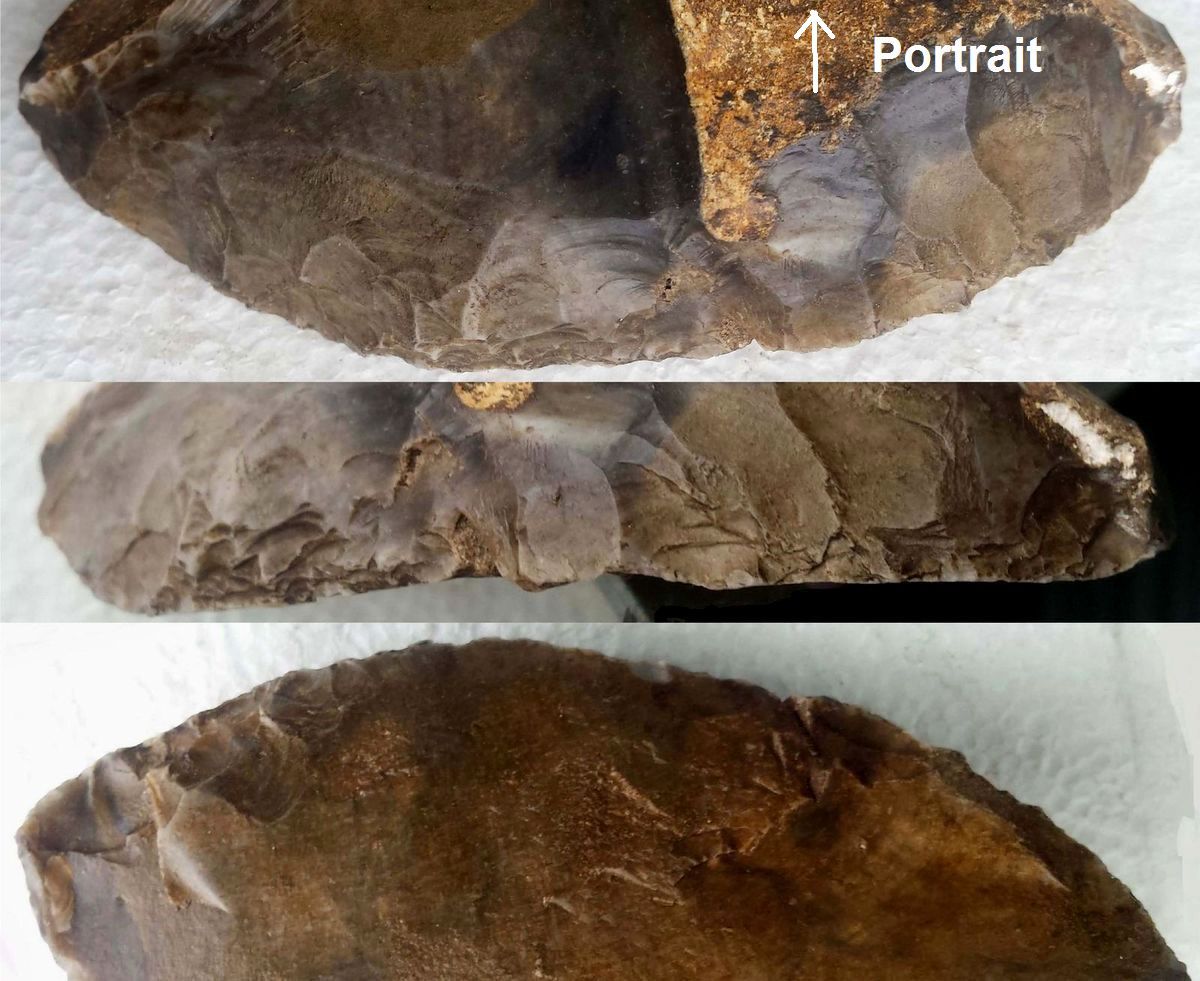
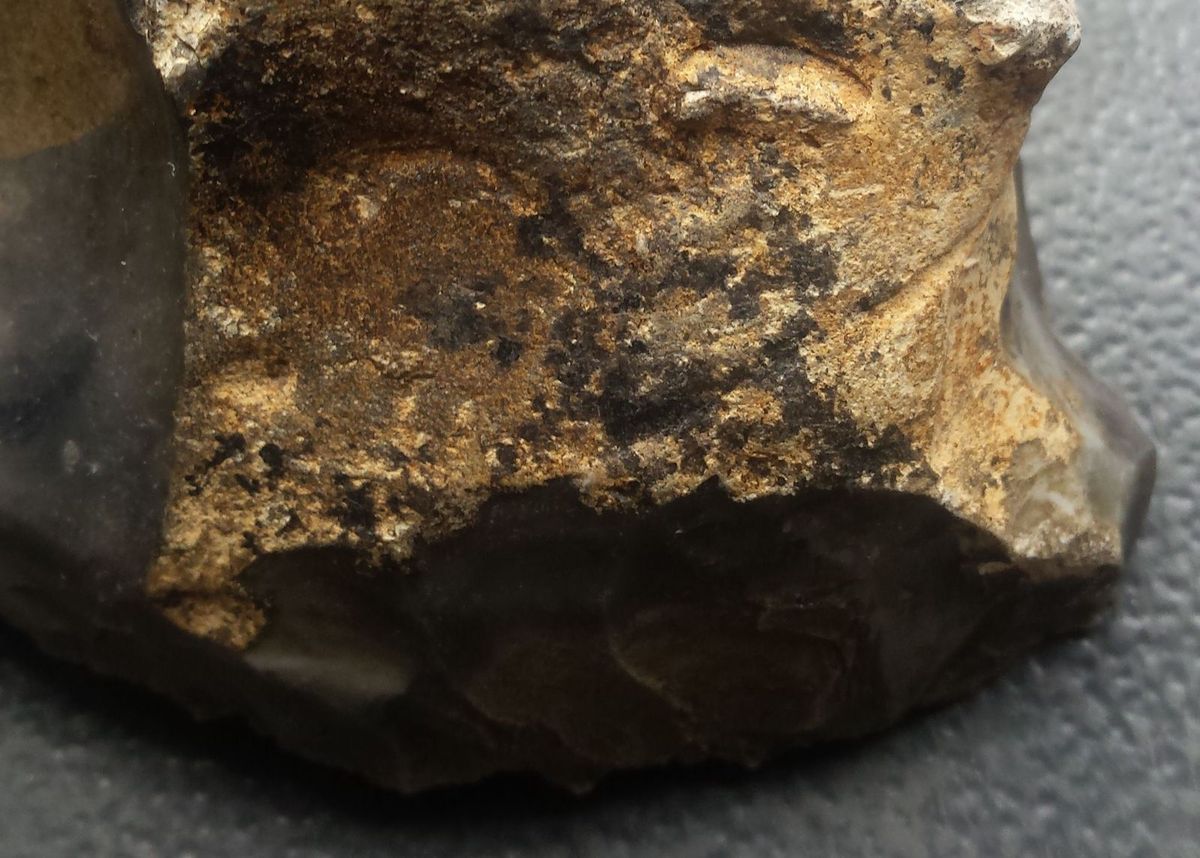
Le racloir présente une grande réserve de cortex, la surface de ce dernier n'est pas plane mais légèrement convexe, il semble présenter des gravures mais il est difficile de les discerner en ensemble. Suivant l'angle de vue et la lumière, les gravures en partie haute (A) ou basse (B) du cortex se voient mieux différemment, ce qui demande un examen séparé des deux parties.
The scraper has a large reserve of cortex, the surface of the latter is not flat, it seems to have engravings but it is difficult to discern them as a whole. Depending on the angle of view and the light, the engravings in the upper (A) or lower part (B) of the cortex are better seen differently, which requires a separate examination of the two parties.
/image%2F1565247%2F20240212%2Fob_38fd75_image-1565247-20231229-ob-e67dec-gratt.jpg)
Les deux plans A et B soumis à des inclinaisons et sources lumineuses différentes.
The two planes A and B subjected to different inclinations and light sources.
/image%2F1565247%2F20240212%2Fob_3be84d_cortex-2.jpg)
partie haute (A) - upper part (A)
/image%2F1565247%2F20240217%2Fob_578deb_wrt.jpg)
On note une gravure en forme de cercle, dont la rondeur est renforcée par des traces noires (certainement parasites), il est partiellement dégagé en partie basse et cerné entre deux gravures prononcées, formant un triangle. Située au milieu arrière du cortex, il y a une gravure nette et profonde en arc de cercle, qu'on retrouve sur l'étude de la partie basse du cortex et la bordure externe arrière du cortex a été taillée, pour parfaire un arrondi (photo ci-dessous).
We note an engraving in the shape of a circle, the roundness of which is reinforced by black traces (certainly parasitic), it is partially exposed in the lower part and surrounded between two pronounced engravings, forming a triangle. Located in the rear middle of the cortex, there is a clear and deep engraving in an arc, which can be found on the study of the lower part of the cortex and the rear external border of the cortex has been cut, to complete a rounding ( photo below).
/image%2F1565247%2F20221026%2Fob_b3ef95_mousterien-oeil-de-l-artiste-neander.gif)
/image%2F1565247%2F20240212%2Fob_d3464e_image-1565247-20231019-ob-21310b-oeil.gif)
le cercle noir n'est pas si parfait, sa rondeur est renforcée par des traces de moisissures.
/image%2F1565247%2F20231204%2Fob_2bc7fb_oeil.gif)
/image%2F1565247%2F20240216%2Fob_66d8c3_z-mousterien-portrait.jpg)
partie basse -(B)- lower part
Une gravure en arc de cercle (1), très prononcée, mentionnée lors de l'analyse de la partie haute et trois autres, une en demi-cercle (2) reliant une autre parcourant tout la partie basse (3) et une petite verticale en arrière (4). Mon pouce donne une idée des dimensions.
A very pronounced arc-shaped engraving (1) mentioned during the analysis of the upper part and three others, one in a semi-circle (2), one running along the entire lower part (3) and a small vertical one at the back (4). The thumb gives an idea of the dimensions.
/image%2F1565247%2F20240212%2Fob_93c8d5_image-1565247-20240102-ob-062212-20181.jpg)
La photo N&B montre la gravure verticale arrière (4).
The B&W photo shows the vertical back engraving (4).
/image%2F1565247%2F20221117%2Fob_1dcb1d_bas-bas.jpg)
Devant la gravure en demi-cercle (2) il y a une zone préparée, ronde et aplanie (hachurée).
In front of the semi-circle engraving (2) there is a round and flattened prepared area (hatched).
/image%2F1565247%2F20230114%2Fob_69904e_portrait-nenadertal-84.gif)
/image%2F1565247%2F20240102%2Fob_09b58e_wwwtrait.gif)
Montage de deux photos (haut/bas) au même plan de l'ensemble du cortex
Montage of two photos (top/bottom) in the same level of the entire cortex
/image%2F1565247%2F20231203%2Fob_9fbb2e_portrait-paleolithique-neandertal-arti.gif)
Comme pour l'art pariétal, l'homme semblait jouer avec la 3D, loin de notre conception contemporaine du visuel que l'on a l'habitude d'apprécier en immédiat. Toutes les gravures ni plus, ni moins, forment un motif de 45mm de haut, qui ressemble à un portrait ou a un animal, quoi qu'il en soit du motif,c'est une création représentative de Néandertal.
As with cave art, the man seemed to be playing with 3D, far from our contemporary conception of the visual that we are used to appreciating immediately. All the engravings, no more, no less, form a pattern 1.77" high, which looks like a portrait or an animal, whatever the pattern, it's a Neanderthal representative creation.
/image%2F1565247%2F20240213%2Fob_b00e94_portrait-mousterien-2nb.jpg)
Cet objet est décrit dans mon article sur "l'art avant l'art" ou l'idée d'une évolution artistique en parallèle entre l'homme de Néandertal et Homo Sapiens (lien) L'Art avant l'art
This object is described in my article on "art before art" or the idea of a parallel artistic evolution between Neanderthals and Homo Sapiens (link) Art before art
| Comparaisons amusantes - Funny comparisons |
un petit air de monnaie gauloise (Sénones) - A little air of Gallic money (Senones)
/image%2F1565247%2F20201206%2Fob_8f0ec7_gaulois-mousterien.jpg)
/image%2F1565247%2F20240214%2Fob_da192e_bruniquelle-grotte-neandertal.gif)
/image%2F1565247%2F20240319%2Fob_965e93_cri-mommie.png)
Ce serait une momie péruvienne découverte en 1877, de la période de la culture chachapoya, du IX au XVème siècle, qui aurait inspiré Edvard Munch pour "Le cri", peint en 1893.
/image%2F1565247%2F20240315%2Fob_17ac87_neandertal-mystere-de-l-installation.gif)


/image%2F1565247%2F20230607%2Fob_a3ac4f_image-1565247-20220418-ob-c905e2-aurig.jpg)
/image%2F1565247%2F20230607%2Fob_c79589_image-1565247-20221001-ob-518bed-lampe.jpg)
/image%2F1565247%2F20230607%2Fob_27aa6e_martin6.jpg)
/image%2F1565247%2F20190418%2Fob_d4768c_pascal-buffard-compteur-2.jpg)
/image%2F1565247%2F20170225%2Fob_e2cf9d_chimu-sonnaille-pascal-buffard-2.jpg)